|
Friday, May 07, 2010
Word on the Street, Jr.
Taking a game for adults and making it accessible for a younger audience is tough. You want to preserve the elements that made the original so fun for older players. You have to consider the cognitive development (and sometimes fine motor control) of younger children. You also want your game's brand to carry through—someone (the parent with the money) should look at your game and say, "I love that game! I bet little whats-its-name will like this kids' version too!" The wrong way to do it is to have your marketing department slap the game’s name and logo on a board with a spinner and hope the kids will be entertained by the random movement of colorful pieces. The right way to do it is like Word on the Street, Jr.
We reviewed the original Word on the Street a while back. It's major fun. We wanted to see how Word on the Street, Jr. held up in comparison. Specifically, we wanted to see if the junior set would engage adults and children at the same time. Sound impossible for a word game? Sound like two great tastes that have no business being in the same kitchen let alone the same plate? THINK AGAIN!! It’s a hoot.
The rules: Word on the Street, Jr. has all the letters of the alphabet running down the center of the game board which depicts a street. Each letter is a tile. Two teams compete to see who can get the most letters on to their side of the street. Teams draw a card with a prompt, such as, "name of a vegetable" and then have 30 seconds to come up with a word that matches the category. The letters that spell the word are moved one space toward the team for each time they appear in the word. For example, "carrot" would move the C, A, O, and T one space but the R would move two spaces. Once a team moves a letter to their side of the street, the letter is out of play and can't be moved the rest of the game.
The Junior version of the game includes the vowels (missing from the original) and the categories are a bit broader to accommodate developing vocabularies. Each category card has two sides, the blue side being a bit tougher than the green side.
I have only played the Junior version and it is plenty nerve-wracking. The 30 second timer keeps the game moving and the challenge is to come up with words that have lots of double or triple consonants. My eight-year-old enjoys playing with me and my wife (the adults play with the no vowels rule), but the most fun I had was in watching my daughter and her friends. The kids caught on to much of the strategy and gave their thinking muscles a work-out. Often they forgot that they were on different teams and volunteered their best responses to whatever category happened to be face up. They yelled. They laughed. They brought out their biggest words. In general, they acted like caffeinated jumping beans — which is a sure indication that major fun is afoot.
If you go to the Word on the Street site, and scroll down a bit, you'll also find a downloadable form you can use to create your own additional cards for the game. This is major cool, because you can make the game engage players on so many more levels with categories like: "12-letter words," "family members," "chores," "word in a Mylie Cyrus song."
Original concept for Word on the Street, Junior by Jack Degnan. Copyright 2009, Out of the Box Publishing, Inc.
Will Bain, Games Taster Labels: Family Games, Kids Games, Word Games

Friday, September 04, 2009
Boggle renewed - introducing the Library Games category
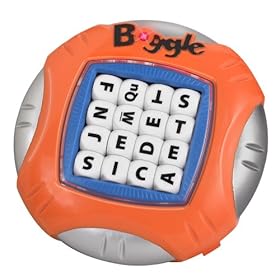 The classic word game Boggle (click to play online) has been repackaged. The game is the same, but it now comes in a sealed plastic case. You twist the case, expanding the cavity that holds the letter dice. You shake the case to make the letter dice change position. You twist the case the other way, the dice all snuggle into their new position, and the timer starts. All you need is paper and pencil. Everything else (even the battery) is included in one handy package (click on the demo tab to see how it works). So there's nothing to lose - except the game.
There's nothing new about the way the game is played, but the new package of this clearly Major FUN game is innovative enough to be worthy of our collective attention. Yes, it's convenient, and could easily be classified as a "travel" game. But because there are no loose parts at all, it's something more.
 Of late, I've been holding many of my Games Tastings at the Irvington Library in Indianapolis. In addition to the Tastings, I've been donating some of our award-winning games to the library so we can start a small collection. The challenge, as you can imagine, is dealing with all the small parts. It takes a lot of dedication to make sure that a game comes back completely in tact. Boggle's new packaging solves that problem beautifully. So exemplary is its design, that it has led me to create a new award category. For want of a better term (I was thinking of Ludotheque, which is French for public libraries devoted to games and play - why France, why don't we have them everyhere, you might ask?), I decided to use "library." It could mean school library, public library, club library, senior center library, even your own personal games library. But the point is, Hasbro has done something exemplary with its new rendition of Boggle - something that makes the game that much more accessible, especially to institutional environments, and hence, that much more worthy of appreciation and recognition. Labels: library, Word Games
Thursday, August 20, 2009
Clabbers and other Scrabble Variants
 Surfing my way, somehow, to a collection of Scrabble Variants, I learned about Clabbers which is a game of Scrabble, all right, but the letters can be in any order you want, as long as they are an anagram of a Scrabble-acceptable word. The author notes that "the board usually ends up tightly packed in places, and necessarily quite empty in others. Game scores will often be much higher than in standard Scrabble, due to the relative ease of making high-scoring overlap plays and easier access to premium squares." That's all I needed to know: higher game scores, each word a puzzle in its own right. My kind of Scrabble. Then there's, of course, Dense Escalating Clabbers for the serious Clabbers-player. The Wikkipedist explains: "Dense Escalating Clabbers add 1/3 more tiles. In addition, every bingo increases a player's rack size by one, and the play times are increased from 25 minutes to 33 minutes 33 seconds. There is also a 100 point bonus for playing a fifteen letter word. These modifications also make the game more challenging and interesting, and also increase the likelihood of triple-triple plays." "Bingo" I deduce, having something to do with using all one's tiles. Then, apparently, there's Volost. A "surreal game" says the Wikipedist, "where the only acceptable words are VOLOST and VOLOSTS." I wasn't really clear about what makes this variation worthy of our collective consideration until I read the last sentence in the article. "It is typically played late at night, and alcohol is usually involved." Ah. Alcohol. I should've known. See also this great collection of potential Scrabble variants on Half-Baked. Labels: Word Games
Wednesday, August 12, 2009
Word on the Street
Take all your consonants except for the ridiculous ones like Q, X and Z. Put them on your satisfyingly hefty bakelite tiles. Now, make a long game board, like a 4-lane highway with a divider strip just wide enough and long enough to accommodate all of your happily hefty letter tiles. Next, get together a deck of 216, often surprisingly laugh-provoking, double-sided category cards, like: "The Brand of Clothing Worn by One of the Players," and "Something that is Wasted," and "Something Used by Scuba Divers," and "A Word that Describes a Car Crash," "A Title Used for Males but not for Females." Add a cardholder and sand timer. And those are all the ingredients needed for a new and notably Major FUN word game called " Word on the Street" from those frequently Major FUN game publishers, Out of the Box.
Everything, of course, except for the rules. And there in lies the tickle.
 Designed by Jack Degnan to give a couple or a couple of teams of word-lovers ample opportunity to demonstrate their brilliance and/or befudlement, the game is a contest to see who, in 30 seconds, can think of a word that 1) fits the category, and 2) has as many as possible of the letters still in play, many of which are doubled - as in MISSISSIPPI which would allow us to move the M one lane closer to us, the P two lanes closer, and the S clear off the board, which would put us one letter ahead. Only 7 more to go and we win!
Though Mississippi would in deed be a coup, it would not be considered a valid response to the category "A Brand of Clothing Worn by One of the Players." To which the best I could do at this time is probably MAIDENFORM (getting to move M twice as well as a D, N, F and R once). Or would MASSIMO with its two M's and two S's be better?
As the game progresses, different letters, and hence different words become more desirable, offensively or defensively, so the challenge keeps on changing. The best word might not have the most double letters in it if some letters only one space away from us, or more enticing yet, one space away from the opponent's goal. The 30-second timer keeps the game moving apace. The cards keep the game surprising and funny. The tiles are large enough for all to read. The board works perfectly in directing player's attention to the strategically most valuable letters. All this makes the game absorbing and delightfully tense, from the moment the first card is read until one team finally manages to capture the eighth letter.
Recommended for 2 to 12 players old enough to appreciate each other's verbal mastery. Labels: Party Games, Tops for 2009, Word Games
Wednesday, July 01, 2009
Bananagrams - a crossword tile game you can play everywhere with anyone
 Bananagrams Bananagrams is a word game that uses letter tiles - 144 unusally finger-friendly, bakelite letter tiles. It will remind you of other letter-tile word games, many other letter-tile word games, until you actually read the rules (which are simple enough to summarize on the 1x2-inch tag that is attached to the banana-like zippable package).  Basically, you draw a bunch of tiles and try to assemble all of them into a crossword array. If you succeed, you draw more. That's about it, basically-wise. The full rules are a bit more complex. Players all get the same number of letter tiles, the exact number depending on the how many are playing. They race to assemble all their letters into a crossword. As soon as one player succeeds, she calls "peel," at which time every player has to take a another letter tile. And so it goes, on and on, until almost all the letter tiles are used up. Naturally, the first player to have used all her tiles shouts "bananas" (if she still has the presence of mind to remember), and wins the game. Everything about Bananagrams is Major FUN, the quality of the tiles, the portability and storability, the adaptability and flexibility. Because the game is so simple to explain, it is also simple to change - to adapt to different skill levels, different environments and time constraints. Read, for example, Lance Hampton's exemplary story of how he plays Bananagrams with his kids. We're working on variations for teams, and maybe even cooperative versions. The Nathanson family, Bannanagram designers, comment: "Obsessed by all the word games that could be found, we all hankered after something a bit more fluid than the classics we all love and wanted a game that the family could play together – ALL ages at the same time. We sought something portable, that we could take with us on our various travels and simple enough (with no superfluous pieces or packaging) that we could play in restaurants while waiting for our food. We love that one hand can be played in as little as five minutes, but as it’s so addictive, it’s often hard to put away!" If you like playing with words, it's very likely that you'll be taking a banana-case full of Bananagrams with you everywhere. Labels: Family Games, Keeper, Tops for 2009, Word Games
Sunday, June 07, 2009
Jumbulaya - a severely challenging strategic word game
 If I wanted to explain the concept of "excruciating fun" to a word game player, I would start with Jumbulaya. You get 100 letter tiles, which are played onto a 9x10 matrix. Some of the letter tiles contain two-letter combinations (QU, CH, ED, ER, LY, ST, TH). Each row in the matrix is for another word. To start the game, the three center columns are seeded with tiles randomly drawn from a conveniently included drawstring bag. Each of up to 4 players then draws 5 more tiles to put on their letter rack. And the game begins. On your turn, you make a new word by rearranging, adding to, trading letters with the letters on any single row. You (temporarily) claim that word by using one of your color-coordinated scoring cubes (matching your tile rack). Until someone else rearranges, adds to, or trades letters with your word, that particular word remains yours. The longer it is, the higher your potential score. And so the game continues, turn-by-turn, word-by-word, until someone builds a 10-letter word, claims all 9 rows, or calls a seven-or-more letter JUMBULAYA. A JUMBULAYA? A JUMBULAYA is a word that can be made by taking one letter from 7 or more of the words already on the board. You can skip word lines, but you can't rearrange the letters. Once all 9 rows contain words, JUMBULAYA can be called at any time during the game, whether or not it is your turn. As for the excruciating part: in the early phases of the game, when it's your turn, you have to consider each of the 9 possible word rows - even those you've already claimed. If you can make one of your words longer, you might be able to keep it from getting claimed by someone else. If you can change someone else's word, you can add to your scoring potential (you get points for every word that you've claimed by the end of the game, the longer the word, the more points). Even when it's not your turn, it pays to think ahead as many moves as you can possibly contemplate (albeit highly likely that the most exciting opportunity for you gets claimed by someone else before its your turn again). And then, any time after all 9 rows have been made into words, there's the JUMBULAYA possibility. There's also the possibility that someone might make a 10-letter word, or that someone might claim all 9 words (either event resulting in ending the game), but the JUMBULAYA possibility is more common and far more fun to contemplate. Since anyone can call JUMBULAYA at any time, you must always reckon with the possibility that if you don't claim enough words quickly enough, the game will be over.  As for the fun part, there are so many things for you to think about, so many opportunities for you to surprise even yourself with your uncanny brilliance, that you become totally absorbed in the challenge. At first, it's a little slow. You have to wait for your turn. Even though you can plan for various possibilities, the unforeseen has it's way of happening before it's your turn again. But once all nine words are claimed and the JUMBULAYA possibility is activated, you are thoroughly engaged, all the time, regardless of whose turn it is. Designed by Julie and Karl Archer of Platypus Games, and distributed by the Farkel Factory, Jumbulaya proves itself to be Major FUN, of the excruciating kind - for people who like word games, and like to think hard. The rules are long, but logical, well-written, and not overly complex. Newbies will probably start playing in less than 15 minutes. The tiles are wooden, rounded, and pleasant to touch. Though it can be played by anyone old enough to appreciate Scrabble®, it is such an intense game that we recommend it especially for groups that are roughly the same age and of similar maniacal tendencies. Want more? Watch this. Labels: Thinking Games, Word Games
Wednesday, May 27, 2009
Letter Roll® - a word game for just about everybody
 It's a word game. It's a party game. It's a family game. It's even a kid's game. It's Letter Roll® - easy to learn, short, intense rounds (lasting one or two minutes each); easily adapted to different skill levels and play preferences, taking some of the best elements from some of the best word games (a little bit of Boggle, a little bit of Major FUN Keeper-award-winning PDQ). Your Letter Roll® box contains seven, hefty, 20-sided (go ahead, count them) dice in three different colors. Two sand-timers (your orange one-minute and your blue two-minute timer), four commodious worksheet pads and four full-sized, sharpened pencils. The different colors of the dice identify the level of difficulty (letter frequency) each die introduces. The two white dice display frequently-used letters, the three blue dice less frequently-used letters, and the two orange dice the infrequently-used, and hence, the most challenging. When it's your turn to roll, you select any four of the dice. This gives you some control over the level of challenge. Choose only blue and orange dice, and you have an extremely challenging round. Choose only white and blue dice for a refreshingly less challenging round. Just to keep power where it most comfortably belongs, an other player gets to eliminate one of your chosen dice, so that ultimately it's not totally your fault if the round turns out to be too easy or too challenging. Once the final selection is revealed, the roller announces the letters rolled, and players race to write down as many unique words as they can think of that use all three letters. As long as each word uses all the letters, it doesn't matter what order the letters are in. (Having the roller announce the letters, by the way, is another welcome, controversy-avoiding touch - as determining which face of the 20-sided dice are actually showing can prove somewhat of a challenge.) Players race to write as many words as they can think of, knowing that at the end of the round they will only score for words that no other player has chosen. When the time is mercifully up, players take turns reading their lists while the rest of the players draw lines through any of the words on their list that get called out. This results in much, somewhat good-natured, but clearly mournful moaning as scoring potential gets graphically reduced. When all lists have been read, players announce and record their scores, getting one point for each unique word remaining on their lists. This encourages originality, cleverness and obscurity, all comfortably confused by a strong element of pure chance.  To further refine the intensity of the game, players can select either timer, the one- or two-minute sand timer, to be used during the duration of the game. The one-minute timer not only shortens the playing time, it also makes the search somewhat less excruciating. The less time you have to think, the easier it is for you to forgive your lexicographic lapses. Designed by Tushar Gheewala, the challenge presented by Letter Roll is so wonderfully flexible that it can be played by kids as young as 7 or 8 (just reduce the number of dice) or by adults in the prime of their linguistic abilities (increase the number of dice, increase the number of letters required for each word). By allowing each player to determine which dice to be used, players can further refine the challenge as each round of the game is played. It's a great 2-player game, and, with only slight modification of the rules, you can have as many as 20 players happily engaged (team play takes the game to an hilarity-inducing level of collaboration and chaos). As with just about every game published by Out of the Box, the components are designed for years of play, the box for easy storage, the rules for clarity and durability. Let those good times roll again. Letter Roll® is Major FUN. Labels: Family Games, Kids Games, Party Games, Word Games
Tuesday, May 26, 2009
Wordquest - probably the most fun you can have with word search puzzles
 What would you call a word search game that is not just a puzzle, but a deeply engaging, and often laugh-provoking contest for 2-4 players? How about if it were not played with paper and pencil at all, but on a board - a very cleverly designed board that reveals the words you are searching for one at a time, and the first person who can find that word must be the first to squeeze a very silly noise maker, and only then can use her own contact-lens-like plastic chips to cover each letter in that word, every letter being connected in a straight line exactly as you would expect in a word search puzzle? And, to top it all off, what if, when the line in which that word was found crosses a word that another player had already created, that player's chips were removed from the board, and, should that result in another word that is already claimed to suddenly become incomplete, those chips as well were to be removed? So that you can never really tell who is winning, even though you might be 40 chips ahead of everyone else, until the very end of the game?  You'd call it two things. You'd call it Wordquest, because that's the name of the game. And the other thing you'd call it would be Major FUN, because it's exactly the kind of game the Major FUN award was designed for. Like almost every game published by Goliath, every aspect of the game is designed for ease of use and long-lasting fun. Each of the 20, differently-themed word search puzzles is printed on a large, laminated disc. The disc is mounted on a round base. A transparent grid provides concave receptacles for the transparent, concave, playing chips. Because the chips and the receptacles are both concave, it is extremely easy to use a finger tip to place and remove them during play. A mounting ring fits on top of the grid and covers all the target words. Rotating the ring reveals each word to be found. Zip-lock baggies are provided for the chips, and four pits surround the playing area so that the chips are easily accessible during play. At the end of the game, everything fits back in the box with ease. Being able to remove words that the opponents have already scored is probably one of the most compelling of all the clever mechanics that have gone into making Wordquest as fun as it is. Though there is no strategy involved in playing the game, when you successfully cross words with another player you get the same sense of smug superiority as you would if your victory were actually justified. And then there's that squeaky, exclamation-mark-like thing that you use to announce that you've been the first to find a word. It makes such a perfectly silly sound that it's almost hard to take it seriously, even if you're the one who didn't find the word. Younger children who are old enough to successfully solve word search puzzles might have difficulty with the small chips and the competitive aspect of the game. We'd recommend it to families with kids who are old enough to appreciate both. And, of course, to anyone who likes the visual and conceptual challenge of word search puzzles. Even if you don't like word search puzzles. Labels: Family Games, Word Games
Sunday, April 19, 2009
PDQ earns KEEPER award
Every now and a Major Fun game proves to be the kind of game we want to keep in our permanent collection - something exemplary. PDQ is one of those games. Originally reviewed here, PDQ has proven itself to be just that kind of game: fun, flexible, easy to learn and teach, one of those games you just wouldn't want to be without. Here is the review again:  PDQ PDQ is a sweet little word game - easy to learn, quick (Pretty Darn Quick) as a matter of fact - a game you can play by yourself or with maybe one, or several or even many other people? You get a deck of 78 letter cards - nice looking, good stock, big, easy-to-read letter cards. You deal out three at a time, face-up. And then you see who can make a word first, or, in case of a tie, who can come up with a longer word. TLP, for example. Tulip. Sure. Or perhaps Platitude. Platitude. Of course. Longer than Tulip. (Did I mention that you can use the letters backwards or forwards?) (Did I also mention that you can use any number of letters before, between or after the three letters that you draw?) (And, of course, the letters have to be in the same order?) Designed by Jay Thompson to be played by kids as well as adults (kids use just two cards at a time, word game experts can try playing with four), PDQ is pretty darn close to everything you would want in a word game - 5-30 minutes of engaging, challenging, and frequently laugh-producing fun. Labels: Family Games, Keeper, Kids Games, Party Games, Thinking Games, Top for 2007, Word Games
Sunday, April 05, 2009
Scrabble Slam
 Scrabble Slam Scrabble Slam is an easy-to-learn, quick-to-play word game for 2 to maybe 6 players of equal word-game-playing skill, and, yes, it's Major FUN. OK, it's not Scrabble. It's more like a Word Ladder puzzle, only without the rungs. And played with cards, rather than paper and pencil. Two-sided cards, actually. 55 of them. Players decide on a four-letter word, then find the 4 cards with the letters needed to spell that word. These cards are laid face-up on the table to spell the word. The rest of the deck is then distributed as evenly as possible between the rest of the players (in case you're concerned: since there are 55 cards, and 4 are played out, you can only get an even distribution with 3 players). If you want to make the game feel more fair, the stronger player should get the extra card. If you're playing as a family, the youngest player should get the fewest cards. Once the target word is laid out, players race to change the word, one letter at a time, trying to be the first to use up all the cards in their hand. So, for example, if the chosen word were PLAY, and you had a card with an N on it, you could cover the Y and make PLAN. If you had an F you could make PLAN into FLAN. If you had a T you could make FLAN into FLAT. And so on, and so on, until someone has no more cards to play.  You don't take turns, so you are under significant pressure, especially if you're playing with equally-skilled players. This makes the game short, and very sweet - especially for the winner. Since the cards have two sides (the letters on the opposite side of a card are indicated by small letters in the corners), there's what one might consider a challenge to one's dexterity - not a big challenge, just big enough to add to the tension and provoke laughter. And yes. There are blank cards, that act just like the blanks in Scrabble. On the other hand, Scrabble it is not. On yet another hand, fun it most definitely is. Labels: Party Games, Word Games
Tuesday, November 18, 2008
A to Z Electronic
 Those of you astute enough to have read our review of the majorly Major FUN-award-winning A to Z might easily assume Fundex's new electronic version would prove as unabashedly praiseworthy. On the one hand, you would be entirely correct in your assumptions. A to Z Electronic is attractive, engaging, and far more convenient. No chips to lose. No boards to keep track of. You don't even need to keep the box. The category cards fit nicely into a compartment on the back of the game. And everything else is integrated into the device. If you already own a pre-electronic copy of A to Z, and are reading this review online, you'll probably find that even though it is far more convenient and compelling. you should expect to spend some time figuring everything out, and, frankly, the original, non-electronic version plays just as well - some might say even better. Though it's all quite logical, and all the lighted buttons are lovely and alluring, and the accompanying sounds meaningfully amusing, there are certain things you just have to figure out. For example, the six buttons on the top of the device are used to indicate both who goes next, and what the category is. There are lights on the left and right to help you (which most ostensibly say "player" or "category"). But you have to remember to look for them. And when it's your turn to "Steal," you have to remember to hold your victim's number button down for several seconds. But it won't take long to learn, and it's clearly worth the effort. The game is so portable, so well-packaged, so attractive and, as you already know, so much fun, that you'll want to take it with you wherever there's the slightest possibility that there'll be people to play with. A to Z, in any form, is a wonderfully adaptable and fun game. Because there are so few components (the device and the cards) and so many lights, the electronic version most definitely adds the convenience, the attraction, and the sheer delight of it all. Labels: Funnest for 2008, Word Games
Friday, April 18, 2008
Attribute
 Attribute Attribute, another minor wonder of strategic silliness from Z-Man Games, is a word game inviting more than a bit of psycho-strategico contemplation. There are two decks of cards: one deck of 60 sheep cards and another of 164 attribute cards. There are only two kinds of sheep in your cutely-illustrated sheep card deck - the green sheep card of topic matching and the red, out-of-topic sheep card. There are 164 kinds of attribute cards, indicated by words like: "spooky," "bleak," "wild," and "furry." Each person gets 4 attribute cards and one sheep card. Let's say you have a red sheep card. You put that card face down, in front of you. One player, anyone, actually, makes up a topic. Really, literally, any topic. For example: crime. You are more or less in luck. At least one of your 4 cards clearly and obviously is unrelated to "crime." For example, "Furry." But perhaps less in luck than you might first have thought. Because if you put down your Furry card it will be fairly obvious to everyone that you are a red sheep. It might have been better to use your "spooky" card, or even the card called "wild." At least you might make someone hesitate. Because, you see, when all is said and done, and everyone has put their sheep face down and an attribute face up, players then select (e.g. grab) any face down pair, the object being to have grabbed a green sheep, and not a red, don't you see. So when all the pairs are on the table, you have to think very, very quickly - is the attribute that's revealed enough like the category to be covering a green sheep? Or is it perhaps a ruse, or a rouge, by any other name? Since Attribute can be played by as many as 8 people, it is definitely a party game. It might also succeed as a family game, depending on age of the youngest players. We'd recommend 10 and above for a mixed age group, and 8-10 for a kids' game. Designed by Marcel-Andre Casasola Merkle, Attribute is a unique and engaging word game. Major FUN. Labels: Funnest for 2008, Keeper, Party Games, Word Games
Tuesday, October 23, 2007
Amuse Amaze
 Amuse Amaze Amuse Amaze is a word game that is not quite like any word game you've ever played. It'll remind you maybe of Boggle, maybe of Scrabble, but it's something else, entirely. There's a board. Actually, there are 18 boards which you assemble in different number and configuration, depending on how many people want to play (2-6). There are 88 plastic letter tiles in their own zip-lock, black baggie. Most of these tiles go onto the board in the empty blue squares. A few of these tiles go to each player, to be placed, oddly enough, face-up in front of the player. And there's a cute little question-mark-shaped playing piece for each player. Wait - I'm still explaining. One board is called the "Start" board. You can tell which board this is because in the center of it, writ large, is the word "Start." Taking a closer look at this board, you'll also notice that there are blue squares (the squares that get seeded with letter tiles), there are squares with letters printed on them. One square is dark brown, with a white letter K in the center. And, here and there, are squares with hedges on them. There are also gardener cards. You get one of them. And cards of different color that correspond to each of the Target boards, about which you currently know nothing. That about sums it up. Now to the fun part. Your goal is to move your piece from the Start square on the Start card to the Target Square on each of the Target boards. You can tell they're Target boards because they include one or several letters in a different color - a color that matches those "cards of a different color" I told you about. You move your piece by making a word, letter-by-letter, from vertically, horizontally or diagonally adjacent squares (hence the Boggle-likeness). Now, as long as it is a real word, you really don't care about what word you make - because you don't get any points for making it. What you do get is a little closer to a Target square. O, sure, making a longer word is good, as is using one of the white letters, because this gives you an extra turn. But your verbal abilities don't count nearly as much as getting to each of the Target squares. I have to say this a couple times, see, because that's one of the things that makes this word game so very different. As to all those letter tiles... If you use a letter tile in making a word, you get to pick it up. This is a good thing to do, because you can also lay letter tiles down as you go, placing them on top of whatever letter is printed on the board, hence making words where no words were there to be made. Assembled, the whole board looks like a maze. There are even uncrossable maze-like hedges here and there, mostly where'd you least want them to be. You have a Gardener Card. Only one. And you can use that, only once, to cut through a hedge. And, to further complicate things, other players are always getting in each other's way, which can be strategically astute and significantly frustrating. Yet, despite all these strange new things, the game is surprisingly easy to understand, and even more surprisingly challenging. It is strategically deep, and significantly fun. Major, one might say, FUN. Labels: Thinking Games, Word Games
Go Mental
 Which of these doesn't belong? guessing
challenge
knowledge
steal
Actually, if you're playing Go Mental from HL Games, they all belong. So that was a trick question, is what it was. Go Mental is a trivia game. Not to trivialize it in any way. Because, despite what you think you know about trivia games, this one's unique. And it comes with 1000 questions. That's one thousand. On 500 cards. And that's a lot of cards. But it's what's on the cards, of course, that really counts. Let me give you a better example. Not a trick question. A real one. From the actual game its veritable self. I begin: ?
Octopus
Squid
Scorpion
Spider
So, which of those things, as they frequently ask on Sesame Street, is not like the others? Did you say Octopus? Nope. Squid is the answer. Why? Because the other three have eight legs or tentacles. And the squid has, how many? That's right - ten. Harder than you thought. And maybe you learned something, even. The game is a race, like so many games of the trivia-type. And there's a race-track-like board. With 30 spaces. So you definitely get that race-like feeling - that sense of getting ahead and falling behind.  Then there are the Challenge Cards. Suppose you get a question, and you're not sure what the answer is. Or better yet, you get a question and you're pretty sure that a certain someone does not know the answer. So, you play a Challenge Card. If you're right about the other person, and he doesn't know the answer, he has to move backwards. Four spaces! O, the humanity! On the other hand, if he does in fact know the answer, he gets to move forward four spaces. Ha ha on you! O, and the Steal Cards. Similar to the Challenge Cards in their card-likeness. But markedly different in drama and overall glee-potential. See, when it's someone else's turn, and you think you know the answer, and this someone else has not yet said anything answer-like, you may slap down one of your Steal cards, shout "Steal," and get to answer the question yourself. Now, when you Steal, you have to get both parts of the question right. That is, you have to not only identify which of the four items doesn't belong, but you also have to explain why. If you are correct on both counts, you get to move four spaces closer to the goal. Wrong? About either part? Guess what? The Steal and Challenge cards are brilliant innovations in themselves, adding significantly to the excitement of the game, keeping everyone involved regardless of whose turn it is. In theory, a game should last about a half-hour. The manufacturers even include a one-minute sand timer to use when people need the hint. There are enough pieces (little plastic brains, no less), to keep 6 players going, mentally speaking. You can also play in teams, which makes everything so much more party-like. Best thing about playing in teams, you don't have to take your own ignorance so personally. Should you be so motivated and wish to include those of the younger persuasion (as young as 8), HL Games offers a supplemental deck of "Fundamental" questions, making it possible for the kids to Go Mental, so to speak, with or without you. O, the fun of it all! Labels: Party Games, Thinking Games, Word Games
Tuesday, September 25, 2007
In a Pickle
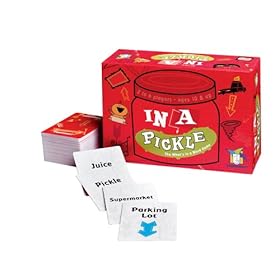 In a Pickle In a Pickle is something you can get easily into, in Gamewright's party-like, family-worthy card game from for 4-6 players, especially. Especially players who like to play with words, and, amongst those, the ones who care more about fun than about winning. You get cards, many cards, 320 many. Every card has a word on it. Every word is a noun. So you give each player a handful of nouns, and you take 4 nouns, place them in the middle of the table, head to head, in a plus sign, arrows out. Arrows. Arrows help you remember the direction of the "fit-into" - for that is the key criteria by which one evaluates one's options - something that fits into something else. In the direction of the arrows. So like, if you had CHICKEN on one of the cards and someone overlaps BALLOON upon CHICKEN, one might be reasonably implying that a CHICKEN can fit into a BALLOON. Similar things could be said about underlapping WHISTLE with CHICKEN because a WHISTLE can fit into a CHICKEN, much to the chagrin of the aforementioned.  The fun makes itself especially apparent during "Pickle Rounds" which are initiated as soon as one of the arms of the plus (the array of cards, face up, on the table) reaches 4. After that, players may ONLY play cards on that arm, the last player to successfully add a card winning all the cards in that arm. O, both goodie and glee! All the cards in an arm!! The success of this game depends a lot on the light-heartedness of the players, in the first place. But if you're a small group of friends, or an actually healthy family, and you enjoy arguing (who doesn't?) you'll probably find it Major FUNLabels: Family Games, Party Games, Word Games
Friday, July 20, 2007
Keesdrow
 If you like word games, especially those of the word-seek, Boggle-type, you should most seriously and assuredly consider immediately purchasing Pywacket's surprisingly well-made, designed, and documented Keesdrow. (Keesdrow, as in word-seek, only spelled sdrawkcab). Surprisingly well. First, of course, the game. Because even though the quality of the pieces and the cleverness of the design and the thoroughness of the documentation are all exemplary, if the game itself weren't fun and challenging and unique, the rest wouldn't matter. The board (made by a random arrangement of 64 tiles, double-sided tiles, each of which has 4 letters on it) presents an array of 16x16 letters. Not to, shall we say, "boggle" your mind, but, do you recall how many letters there are in the original, Parker Brothers version of Boggle? Did you say 16? And did we say that Keesdrow has 16 times 16 letters? Why, yes, we did. So, one might easily conclude that Keesdrow is Boggle overkill. Words are created by connecting letters that are horizontally, vertically or diagonally adjacent - as would be familiar to any Boggle player. Each time a letter is used, it is marked with a peg. When a pegged letter is used (a letter is used for the second time) to make a word, that peg is replaced with a different peg of a different color (yellow), and the letter's score-value is doubled. When that letter is used a third (and last) time, a red peg us used, and the letter's score is tripled. This makes every letter of increasing strategic value - so the temptation is to build from other people's words, focusing on one small area of the board. And thus, quite brilliantly, keeping the players from being totally overwhelmed by all the possibilities. There's also a unique double letter rule, where you can use the same letter twice in a row or in the word, doubling back, as it were, if you need, and of course adding to your score as you make your green pegs yellow, and your yellow, red. And, to encourage players to widen their use of the board as the game continues, letters marked with a red peg are "dead" and can't be used again. All of this just about guarantees that you will be taken completely by surprise by each other's brilliance - all of you looking at the same cluster of letters and suddenly someone finding a word that was everso blatantly there and yet completely invisible to you. Hence, the Majorness of the FUN. Finally, there's a two-minute timer, just to keep things in perspective. In the deluxe version, the letter tiles are made of wood. For five dollars less, you can get them made out of plastic. Which maybe less appealing aesthetically-speaking, but perhaps even more durable. Everything else, deluxe or regular version, is the same. A plastic box, divided into three compartments, stocked with three different colored pegs. A folding board that acts as a frame, and a set of carefully illustrated, full-color instructions completes the package. Recommended for 2 to 6 players, 8 to adult. Though if you have more than 4 players, more than childlike patience will be required. It's also helpful if players are relatively equally skilled, or as much imbued with compassion as with the love of wordly challenge. Labels: Thinking Games, Word Games
Thursday, July 19, 2007
Snatch
 Snatch Snatch, based on the Victorian word game of anagrams, is a very portable and nicely executed word game from US Games Systems, Inc.. Anagrams, under any name, is a word game you should know about. It is elegantly simple, with very few rules, and yet can become remarkably absorbing, intense, and challenging for even the best of word game players. The look and feel of the tiles is an important contribution to an overall excellent game, hence, our most wholehearted endorsement of Snatch. You begin with a pool of letter tiles, all turned face down. On your turn, you turn over any tile. Then it's the next player's turn. As soon as any player sees a word that can be made from the exposed tiles, that player calls the word out and wins the tiles for herself. She places the tiles in front of her, face-up, so that all players can see her word. The game continues, tiles turned over one per turn, so to speak. Now here is the excruciating part - if any player can add some exposed tiles to one of your words so as to change it into a different word, that player can claim your tiles. So: 1) you never really own anything until the very end of the game, and, 2) as the game progresses, there are more and more snatch-worthy words to contemplate. Especially those long words. So Snatch, even though it is not in itself a new game, is clearly Major FUN. It is reasonably priced, attractive, well-executed, the plastic tiles are smooth to the touch and slide easily on tablecloth or tabletop as you rearrange them (which you do often) - all the things you want in a good game. Though it can be played by as many players as are interested, we've found that it's best in a smallish group (2-4) of people who are equally adept, word-wise, and equally competitive, reaction-time-wise. Labels: Party Games, Thinking Games, Word Games
Thursday, April 05, 2007
Poppo
 Poppo Poppo is what you might call "educational" and what you might even consider a "reading" game, and what you more than likely would classify as a "competitive" game for "little kids." In all cases, you'd be absolutely correct, and, simultaneously, wrong. Remember a game called " Trouble?" My guess is that what you remember best about it is the "Pop-o-matic" thingy in the middle of the board - a transparent capsule housing a die, that you'd press down, let go, and watch it pop the die to a new number. And that's what you remember so well because popping the pop-o-matic was probably the most fun part of playing the game. Well, that's what at the heart of Poppo. Only the die is 8-sided instead of 6. It has letters on it instead of numbers. And there are two sets of 4 different die-poppers, each with a different combination of letters. In addition to the die-poppers of endless delight, you also get a a box of cards with 100 different 3- or 4-letter words (illustrated), and a one-minute sand timer. A card is drawn, the timer turned, and two players (or teams) race to be the first to get their Poppo-poppers to spell the word on the card. And that's just about it. You can play it as a solitaire, you can play it cooperatively, you can play it with kids from 4 on up. You read me right, 4-years-old and up.  I first "tasted" it with a group of junior high school kids in a special education class. We evolved the "cooperative" approach together, because it was more fun. Some of the kids just wanted to keep popping - even after they managed to pop their Poppo-poppers to one of the letters in the word we were trying to spell. Others were frustrated by the time pressure. Others had trouble figuring out what letters were available in which Popper. (Each Popper has a different selection of letters, but here's also a wild card on every Popper- so, even if you have the wrong Popper, you'll eventually be able to spell the word anyway.) So we played it together, using all the Poppers, trying to see how many words we could spell before the timer ran out. Aside from the multitude of instructional benefits that so clearly qualify this game for parental purchase, the important thing is that it's something kids will want to play again and again. There may be faster ways to teach reading or spelling or word recognition, but I don't think there's a way that is more fun than playing Poppo. Labels: Family Games, Kids Games, Word Games
Monday, January 29, 2007
PDQ - a game for all reasons
 PDQ PDQ is a sweet little word game - easy to learn, quick (Pretty Darn Quick) as a matter of fact - a game you can play by yourself or with maybe one, or several or even many other people? You get a deck of 78 letter cards - nice looking, good stock, big, easy-to-read letter cards. You deal out three at a time, face-up. And then you see who can make a word first, or, in case of a tie, who can come up with a longer word. TLP, for example. Tulip. Sure. Or perhaps Platitude. Platitude. Of course. Longer than Tulip.  (Did I mention that you can use the letters backwards or forwards?) (Did I also mention that you can use any number of letters before, between or after the three letters that you draw?) (And, of course, the letters have to be in the same order?) Designed by Jay Thompson to be played by kids as well as adults (kids use just two cards at a time, word game experts can try playing with four), PDQ is pretty darn close to everything you would want in a word game - 5-30 minutes of engaging, challenging, and frequently laugh-producing fun. Labels: Family Games, Kids Games, Party Games, Thinking Games, Top for 2007, Word Games
Monday, January 22, 2007
Acronymble
.jpg) Acronymble Acronymble is most definitely a party game, and most assuredly a game that will make you laugh. Hence, most probably, Major Fun. MAJOR. As in More Active Jollies Organized Ridiculously, or, perhaps Mighty Attractive Jauntiness Of Ribaldry, or even Mellifluent Acronym Judging Oscillates Randomly. Players compete (more or less) to create phrases or sentences (you get an additional point of your acronym is a sentence) from a collection of randomly drawn tiles. The number of tiles is determined by the draw of a card from the Length Deck. And what you have to do with them is determined by the draw of a card from the Composition deck. There are four different kinds of cards in the Composition deck: one tells you to also use a nonsense word, another to use only words that start with the same letter, and another to select any word starting with the chosen letter, and make an acronym from it. And the fourth kind of card tells you to do what you would have done anyway without the card.  Everyone but one player (the master of ceremonies for that round, a.k.a. the "NYMWIT") votes for a favorite. Votes are tallied. Players move the corresponding number of spaces on the board, et, obviously, cetera. How long you have to think is determined by the throw of a die, which tells you how much time to set on a tension-inducingly noisesome kitchen-type timer. The rules are written with enough humor and playfulness to keep people from taking the rules too seriously - there are constant invitations to make up your own rules, suggestions like "If a player doesn't finish in time, don't disqualify them (maybe drum your fingers or whistle a bit)." Whistle and drum we did. Laugh a lot we also did. Major FUN was most definitely had. Labels: Party Games, Word Games
| |


